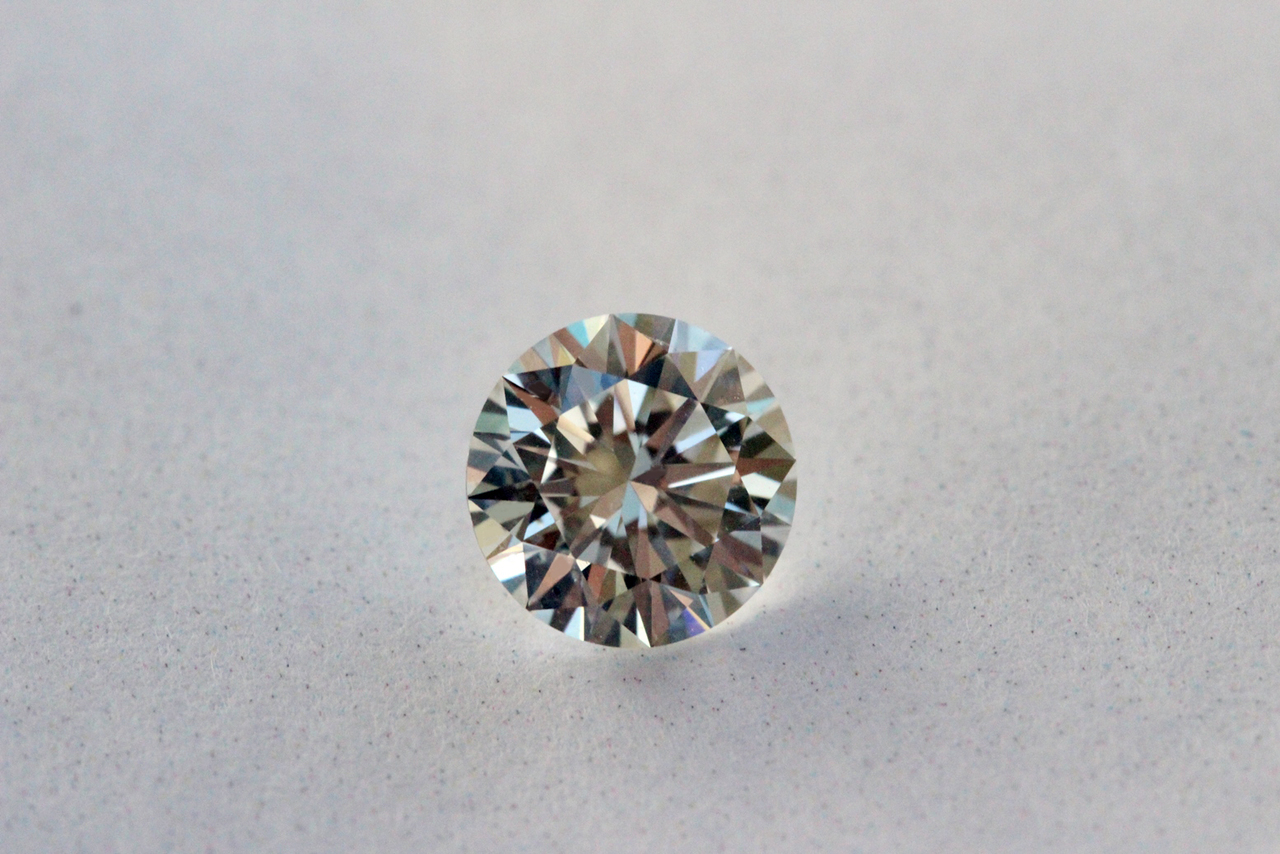
Eye Clean Diamond: How to Buy SI1 and SI2 That Looks Flawless for Less
A diamond graded SI1 and a diamond graded VVS2 can sit side by side on a tray, both look identical to your unaided eye at arm's length, and differ in price by 30 to 50 percent. The grading report is describing what a trained grader sees under 10x magnification with a loupe — not what you, your partner, or anyone at a dinner table will ever see. That gap between lab-grade scrutiny and naked-eye reality is the single largest source of recoverable money in a diamond purchase, and the term that captures it is "eye clean."
An eye clean diamond is one whose inclusions are invisible to a person with normal vision viewing the stone face-up at a normal distance — roughly 10 to 12 inches, in ordinary light, without magnification. It is not a grade. No lab, GIA included, prints "eye clean" on a report. It is a property you verify yourself, and the whole game is finding it in the cheapest clarity grade that reliably delivers it.
What "Eye Clean" Actually Means (and What the Lab Won't Tell You)
The GIA clarity scale runs Flawless, Internally Flawless, VVS1/VVS2, VS1/VS2, SI1/SI2, then I1/I2/I3. Every grade above SI is defined by inclusions that are difficult to see under 10x magnification. That standard has almost nothing to do with your eyes. By the time an inclusion is large enough to see unaided, you are usually well down into the SI and I range — which means the entire VVS-to-VS span is paying a premium for cleanliness no one perceives without a loupe.
Here is the part marketing departments prefer you don't internalize: an eye-clean SI1 and a VS2 look the same on your hand. You are not buying a worse-looking diamond by dropping to SI. You are buying an identical-looking diamond and declining to pay for invisible perfection.
The catch is that "eye clean" is not guaranteed at any grade below VS. It is a probability, and the probability depends heavily on grade, shape, and — most of all — where the inclusions sit.
The rough odds, by grade
These are working approximations from the trade, not lab-published statistics, and they assume a round brilliant of about one carat:
- VS2: roughly 95 to 99 percent eye clean. You can almost buy on the report alone.
- SI1: roughly half are eye clean. This is the sweet spot — and the grade that demands actual inspection.
- SI2: roughly 10 to 15 percent are eye clean. A minority, but they exist, and they are the cheapest flawless-looking stones on the market.
- I1 and below: rarely eye clean in white diamonds; treat as a separate, riskier conversation.
The implication is direct. If you buy VS2 sight-unseen you overpay slightly for certainty. If you buy SI2 sight-unseen you are gambling. The disciplined move is to hunt in SI1 and SI2 and verify each candidate individually, because within those grades the price is low and the variance is enormous.
Why Inclusion Location Beats the Grade Letter
Two SI2 diamonds can carry the same grade for opposite reasons. One has a small feather tucked near the girdle edge, hidden under a prong once set. The other has a dark crystal sitting dead center under the table — the flat top facet you look straight through. Same letter. One is invisible on the hand; the other shows a pinpoint of black you'll notice every time you glance down.
This is why a reductive "never go below VS1" rule wastes money: it treats the grade letter as the signal when the real signal is the inclusion map.
When you read a report, the plot diagram (or the lab's high-resolution images) is more useful than the grade. Rank locations roughly worst to best:
- Under the table, center — worst. Maximum visibility, nothing to hide it.
- Under the table, off-center — still exposed, slightly less obvious.
- Out toward the crown facets / bezel area — broken up by faceting, harder to catch.
- Near or under the girdle — often concealed by the setting and prongs.
And the nature of the inclusion matters as much as the spot. Rank those too:
- White or transparent feathers, crystals, and needles scatter or transmit light and frequently vanish to the eye even when sizable.
- Dark or black crystals and large dark clouds absorb light and read as a visible dot — these are the ones that kill eye-clean status at the smallest size.
- Twinning wisps and graining are usually no visual issue face-up.
- Surface-reaching feathers near the girdle deserve a durability check (ask the lab or a gemologist whether it threatens the stone), separate from appearance.
A loud white feather off to the side can be eye clean. A tiny black crystal under the table is not. The letter tells you neither — the map does.
The Money: What Eye-Clean SI Actually Saves You
Real ranges, not invented figures. For a well-cut round brilliant in the G–H color range, roughly one carat, natural mined:
| Clarity | Typical 1 ct natural range | Eye-clean odds | What you're paying for |
|---|---|---|---|
| VVS2 | ~$6,500–$9,500+ | ~100% | Loupe-clean cleanliness no one sees |
| VS1 | ~$5,500–$8,000 | ~99% | Near-certainty, modest premium |
| VS2 | ~$5,000–$7,500 | ~95–99% | Safe sight-unseen buying |
| SI1 | ~$3,800–$6,000 | ~50% | Best value — if you inspect |
| SI2 | ~$2,800–$4,800 | ~10–15% | Cheapest flawless-looking — if you hunt |
Numbers move with the market, color, exact cut quality, and fluorescence, so treat them as ranges and confirm live. The structural point holds regardless of the day's prices: dropping from VS2 to a verified eye-clean SI1 typically saves on the order of 10 to 25 percent for an identical face-up appearance. SI1 to a verified eye-clean SI2 can save a further 15 to 25 percent.
Put concretely: on a one-carat round, choosing a verified eye-clean SI1 over a VS2 of the same color and cut commonly puts roughly $1,000 to $2,000 back in your pocket — for a diamond that looks the same across the table. (Lab-grown follows the same structure at a fraction of the absolute price; the percentages between grades behave similarly.)
That saved spread is best redeployed into cut quality, which actually drives how the diamond looks — brightness, fire, light return — far more than the invisible difference between SI1 and VVS2.
Shape Changes Everything
Eye-clean odds are not uniform across shapes, because facet patterns hide inclusions differently.
- Round brilliant is the most forgiving. Its 57–58 facets and intense sparkle break up and mask inclusions. SI1 is a strong target; eye-clean SI2 is findable.
- Brilliant-style fancies — oval, cushion, pear, marquise, radiard — behave similarly to rounds; their faceting also hides flaws reasonably well.
- Step cuts — emerald and Asscher — are unforgiving. Long, open, mirror-like facets and a large open table give inclusions nowhere to hide, and they reveal body and clarity plainly. For these, move your target up: VS2 is the safer floor, and eye-clean SI is genuinely hard to find. SSEF, Gübelin, and GIA reports won't flag this for you — it's a function of the cut, and you account for it by raising the clarity bar.
- Princess cuts can hide inclusions in the body but are vulnerable at the pointed corners, where a feather is both more visible and a chip risk.
Match the clarity hunt to the shape. Chasing an eye-clean SI2 emerald cut is a low-yield search; chasing an eye-clean SI1 round is a high-yield one.
How to Verify Eye-Clean Before You Pay
This is the section that earns the savings. Never accept "it's eye clean" from a seller as a finding — it's a sales claim until you've confirmed it. A diamond is only worth the SI discount if you have verified the cleanliness the grade doesn't guarantee.
Buying online (where the inventory and value are)
- Demand a real grading report from GIA, AGS (legacy reports), or IGI. No report, no purchase. The report anchors carat, color, cut, and the inclusion plot.
- Open the high-resolution image or 360° video at full magnification. These are typically shot at 20x to 40x — far closer than your eye will ever get, which is exactly why a stone can look "busy" on screen and be flat-clean in life.
- Locate the worst inclusions on the image, then cross-check against the plot diagram so you know their type (dark crystal vs. white feather) and exact position.
- Zoom out until the on-screen diamond is roughly life-size — about the width of your fingernail. Can you still pick out those inclusions? If yes, it is not eye clean. If they disappear, it likely is.
- Ask the seller's gemologist directly, in writing: "Is this stone eye clean face-up at 10 inches to normal vision? Are any inclusions dark or under the table center?" Get the answer in text. A reputable dealer answers plainly; evasion is information.
- Confirm the return policy covers eye-clean specifically — that you can return it if it isn't clean to your eye on arrival. Then inspect it the moment it lands, in daylight, before resizing or setting.
What to say at the counter (in person)
Hand the stone back to the salesperson and run this script:
- "Please show me the GIA or IGI report and the plot diagram for this exact stone."
- "Where are the inclusions, and are any of them dark or directly under the table?"
- "Let me hold it face-up at reading distance in this light." (Look straight down through the table. Move it gently. Hunt for any dark point or cloudiness.)
- "Now under the loupe, please." (Confirm the report matches the stone — that you're being shown what you're paying for.)
- "If a gemologist re-examined this independently, would it come back eye clean?"
Inspect face-up first, then magnify. Reverse it and your eye, primed by the loupe, starts inventing problems at normal distance that aren't there. Also view in more than one light — a stone that's clean in warm jewelry-store spotlights should also be clean in plain daylight near a window.
The Bottom Line
The cheapest clarity grade that still looks flawless is usually SI1, sometimes SI2 — but only the specific stones you've verified, and only in shapes that hide inclusions. The grade letter is a lab's loupe-level description, not a verdict on appearance. Read the inclusion map over the grade, weight location and color of the inclusions over the letter, raise the bar for step cuts, and confirm cleanliness with your own eyes before money moves.
Do that and you capture the structural inefficiency in diamond pricing: the premium the market charges for perfection no one can see. Pocket it, or spend it on cut — where it shows.
CaratWire is independent and takes no payment from sellers. Always verify any individual stone against its current grading report from GIA, IGI, or AGS before purchase.