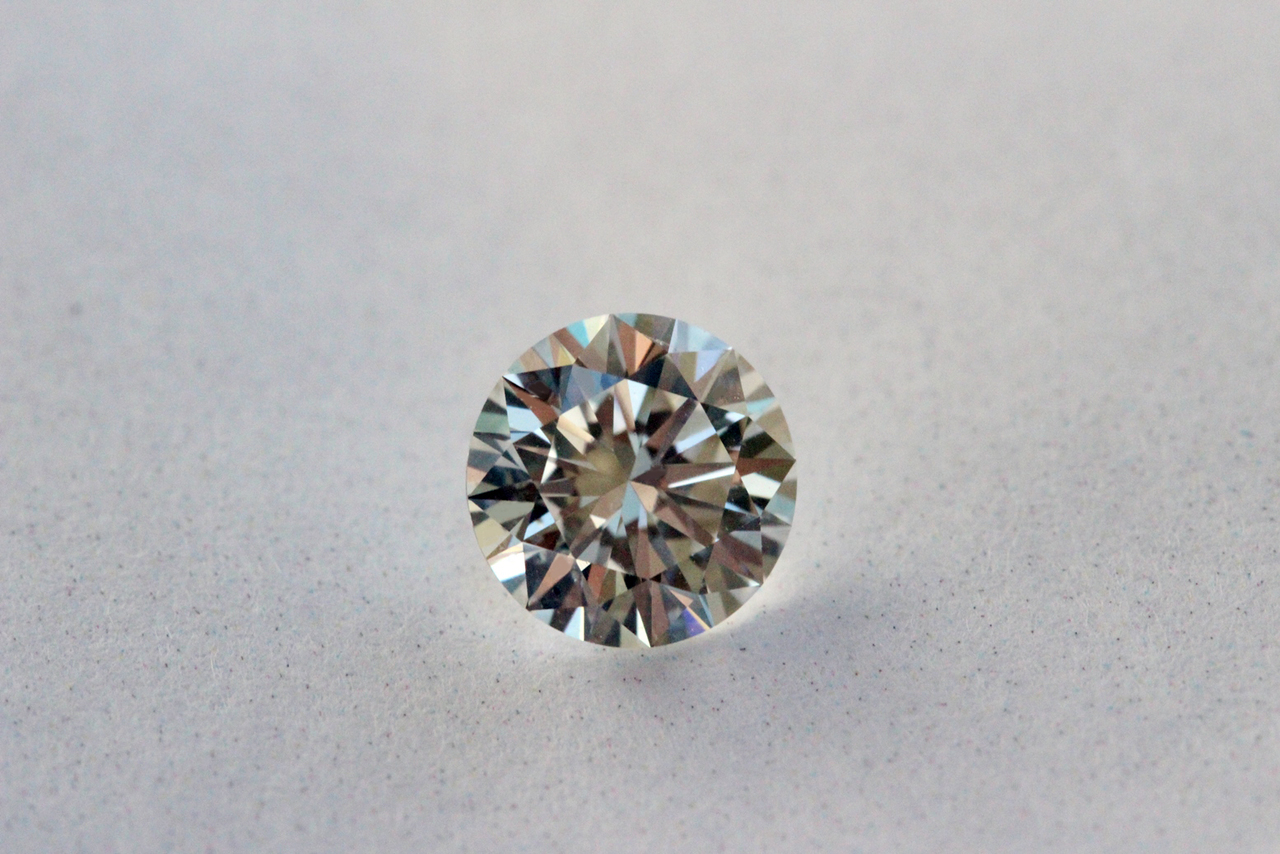
Diamond Cut Grade: The Only C That Makes a Diamond Sparkle
Put two 1.00-carat round brilliants under the same lamp — both F color, both VS1, both GIA-graded — and from across a dinner table one of them is visibly more alive than the other. Same carat, color, clarity, and lab — the variable doing all the work is the diamond cut grade: the one C that color and clarity can't buy back. Color and clarity describe the rough the cutter started with. Cut describes what the cutter did with it, and it is the only line on the report that governs how light behaves once the stone is on a hand.
That asymmetry is also where the money is. Downgrade color one step (G to H) and you typically save 10–15% with no loss face-up. Downgrade cut to chase that saving and you lose the one thing you're actually paying a diamond to do. A top-cut round commonly carries roughly a 10–25% premium over a mediocre cut at the same carat, color, and clarity — and unlike a clarity bump you'll never see, that premium buys behavior you can watch from across the room. Of the 4Cs, cut is the dollar that shows.
What the diamond cut grade actually measures
Cut is not shape. "Round brilliant," "cushion," "oval" — those are shapes. The diamond cut grade is a measure of how well a stone's proportions, symmetry, and polish convert incoming light into returned light. The trade breaks that returned light into three components:
- Brightness (brilliance): white light reflected back to the eye.
- Fire (dispersion): white light split into spectral colors.
- Scintillation: the pattern of sparkle and contrast as the stone or the light moves.
There's a reason cut alone creates sparkle. Color and clarity are inherent to the crystal — graded, not created; a cutter can't add color or remove an inclusion. Light performance, by contrast, is built by choosing angles. The same rough faceted to ideal angles versus cut deep to hold weight yields two stones with two grades and two prices. Cut is the only C that is a human decision, not a geological fact.
A critical limitation: GIA only assigns a cut grade to standard round brilliant diamonds. Ovals, cushions, emerald cuts, pears, and other fancy shapes get no cut grade on the standard GIA report — only polish and symmetry, which are finish grades, not light-performance grades (a supplemental AGS Ideal Report can add a light-performance grade for eligible fancy shapes). So on a fancy shape you're flying without the single most useful number, and you lean instead on proportions, video, and your own eye.
The proportions that drive light return
For round brilliants, a handful of measurements do most of the work. You don't need the optics memorized — just enough to read these off a report and know whether they sit inside the range that performs.
| Parameter | Performs well (round brilliant) | What it does |
|---|---|---|
| Table % | ~54–58% | Top facet; too large drains fire, too small dims brightness |
| Depth % | ~59–62.5% | Overall height; outside this, light leaks out the bottom or sides |
| Crown angle | ~34–35° | Drives fire; works in tandem with the pavilion |
| Pavilion angle | ~40.6–41° | The single most error-sensitive angle for light return |
| Pavilion depth % | ~42.5–43.5% | The geometric expression of the pavilion angle |
| Girdle | Thin to slightly thick | Too thin chips; too thick hides weight you paid for |
| Culet | None / very small | A large culet shows as a window through the table |
The pavilion angle deserves singling out: it's the most error-sensitive measurement on the stone. As a trade rule of thumb, roughly a 0.5° deviation from the ideal window measurably degrades light return, pushing light out the side instead of back to your eye. Crown and pavilion also interact — a slightly steeper crown can be balanced by a slightly shallower pavilion and still perform — which is why two stones with different individual numbers can both look excellent, and why you judge the combination, not any single line.
Two failure modes worth recognizing by name, because they cost money:
- Fish-eye: a shallow pavilion produces a grey reflection of the girdle visible through the table — a dead ring around the center.
- Nail-head / dark center: a too-deep pavilion produces a dark, lifeless core under the table.
Both occur in stones that grade well on color and clarity, neither is fixable, and both are visible to an unaided eye once you know to look.
Why "triple-Excellent" is a wide range, not a guarantee
"Triple-X" — GIA Excellent cut, Excellent polish, Excellent symmetry — is marketed as the ceiling. It isn't a point; it's a wide band. GIA's cut scale (Excellent, Very Good, Good, Fair, Poor) is deliberately tolerant: the Excellent bucket spans a large set of proportion combinations, and stones at its edges do not perform like stones at its center.
This is structural, not a defect: a range grade exists so that many good stones qualify, which makes "GIA Excellent cut" a floor to clear, not a finish line. A meaningful fraction of GIA Excellent rounds would land a tier lower on the AGS light-performance system, which graded actual light return (ray-traced ASET maps) rather than proportion windows — historically the stricter read on cut. AGS Laboratories closed at the end of 2022 and merged its lab operations into GIA, but the AGS cut standard stayed with the American Gem Society and is now offered through GIA as the supplemental AGS Ideal Report. The point holds: a range grade hides a spectrum, and a tighter light-performance standard still cuts through it.
Practical consequence: don't stop at the word "Excellent." Inside triple-X is a tighter target the trade calls "ideal" proportions — the narrow subset of the table above, not a competing standard. Aim for the center or lower half of each range, not its edges. Stones in that center, with strong optical symmetry (the precision of facet alignment, confirmed by a hearts-and-arrows scope or an ASET image, not the report's symmetry grade alone), are the ones that sparkle hardest. For the dollar math on when to pay the ~$25 for the AGS Ideal 0 supplement inside GIA Triple Excellent — and when a Very Good round is defensibly the better buy — see the tier-by-tier decision.
What the cut premium actually costs
Cut is the one place in the 4Cs where paying up is easiest to defend: the gap you're closing is the one your eye can see. Two ranges, kept separate to keep the math honest:
- Top-cut versus mediocre cut. Set a center-of-range round with verified optical symmetry against a genuinely middling one — a low-end Excellent, or a Very Good with steep or shallow angles — at matched carat, color, and clarity, and the well-cut stone typically commands a 10–25% premium. That is the spread between returning light and leaking it.
- The top-end tightening. Inside the well-cut band, moving from a mid-pack Excellent to a center-of-range "ideal" with confirmed hearts-and-arrows symmetry is a narrower step — on the order of 5–15%. That is polish on an already-good stone.
Weigh that against the other Cs. A clarity step you can't see face-up — VS1 to VVS2 on an eye-clean stone — can run 15–25% or more, and an invisible color step runs 10–15%. Spend there and you're buying letters on a report; spend on cut and you're buying the behavior the diamond exists for. Cut is the best-spent premium of the 4Cs — fund it with the savings from color and clarity bumps no one will notice.
A quick word on labs, because it bears on what the grade means. GIA and AGS were historically the strictest on cut; AGS pioneered the ray-traced light-performance read now offered through GIA as the supplemental AGS Ideal Report. GCAL goes further on optics — a light-performance grade plus an optical-symmetry (8X) determination, backed by a guarantee tied to the grade — which is why you'll see GCAL paper on stones sold specifically on cut. IGI grades much of the lab-grown market, and in the trade's view its Excellent tolerances read wider than GIA's, so "Excellent" can mean slightly different things across letterheads. Anchor on the proportions and the video, which don't change with the logo at the top.
What to do at the counter
Run this sequence, ordered so the cheap checks come first and the stone earns each step.
- Demand the grade — and the shape caveat. For a round, the report must carry an actual cut grade; accept Excellent as the floor. For a fancy shape there is no cut grade, so tell the seller you'll judge by proportions and video — and ask whether a supplemental AGS Ideal Report exists for it.
- Read the proportions, not just the word. On a round, check table, depth, crown angle, and pavilion angle against the table above. If crown or pavilion sits outside the window, ask why — and weigh the pair together.
- Ask for the ASET and/or hearts-and-arrows image. This shows light return and optical symmetry directly. On an ASET the colors map angles: red is high, direct return (what you want most), green is lower-angle, less-ideal light, blue marks the contrast that creates scintillation, and white or black is leakage. A clean ASET reads as strong structured red with deliberate blue contrast and no large white/black zones — worth more than another adjective on the report.
- View it three ways. Under spot lighting (fire), under diffuse office lighting (brilliance), and at arm's length (does it carry across a table?). Rock the stone — scintillation should be lively, not patchy.
- Hunt the two killers. Look straight down through the table for a fish-eye ring or a dark nail-head center. Either one, walk.
- Confirm the report matches the stone. Check the girdle inscription number against the certificate — you're buying this stone, not a grade printed for another.
Script for the case: "For this round, what are the crown and pavilion angles, and can I see an ASET or hearts-and-arrows image? I'm comparing optical symmetry, not just the Excellent grade." A counter that answers quickly is set up to sell you cut. One that deflects to color and clarity is steering you toward the C you can't see.
The bottom line
Color and clarity matter at the extremes, but they are negotiations with geology — you pay for what the crystal already is. The diamond cut grade is the only line where the money buys behavior: how the stone moves light on a hand, across a room, in the seconds someone looks at it. Treat "Excellent" as the floor, aim for the center of the range, verify with an ASET, and route the dollars saved on invisible clarity bumps into the one C that does the work.