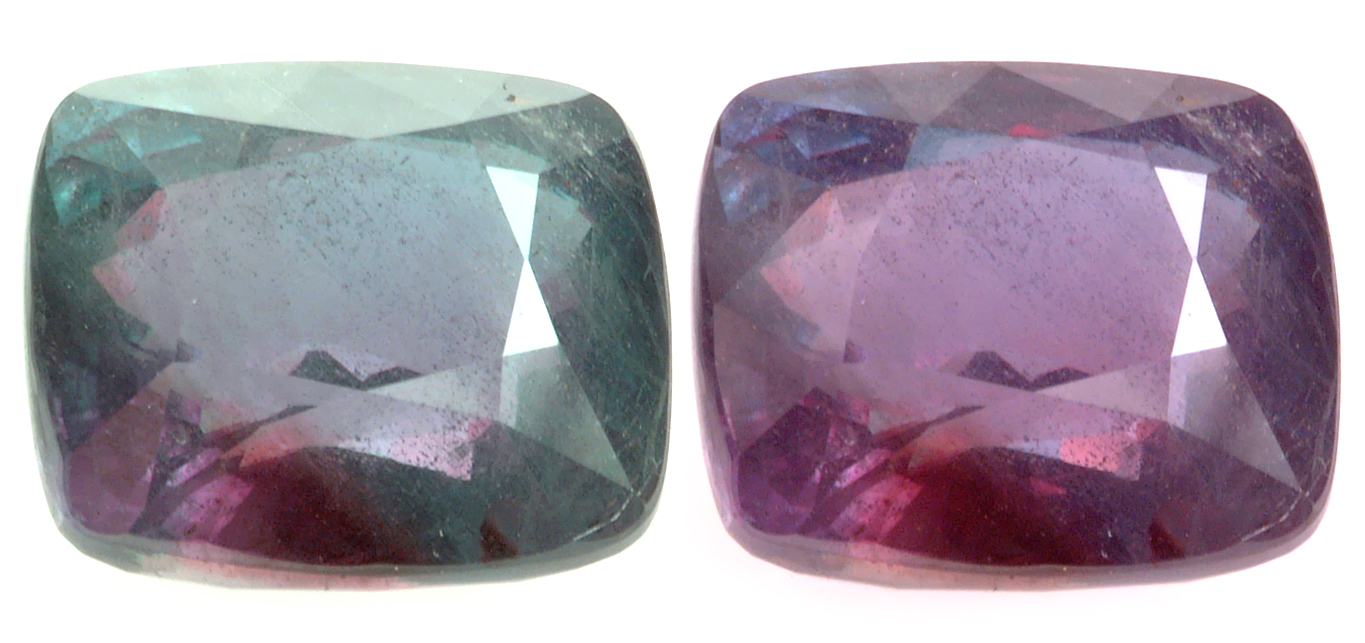
Alexandrite Buying Guide: Color Change, Origin, and What You're Actually Paying For
A fine Russian alexandrite with a near-total green-to-red shift has fetched on the order of $60,000 and up per carat at major auction. The lab-grown crystal that looks almost identical to an untrained eye costs roughly $40 a carat at wholesale. That spread — better than a thousand to one — is the entire problem this alexandrite buying guide exists to solve. Alexandrite is the chrysoberyl variety that reads green to bluish-green in daylight and red to purplish-red under incandescent light, and the gap between a stone that genuinely does this and one that "kind of" does — or that was grown in a furnace last year — is where almost all the money is won or lost. This guide is for someone about to wire real money, so we'll deal in mechanisms, ranges, and the specific lab language that protects you.
What an Alexandrite Buying Guide Won't Tell You About Color Change
The color change is not a marketing flourish layered on top of the stone. It is the stone's value. Chrysoberyl picks up trace chromium that absorbs light in a narrow band; daylight (rich in blue-green) and incandescent light (rich in red) each survive that absorption differently, so the same crystal sends back green under one and red under the other. Every alexandrite does this to some degree. The question is degree — and that degree is precisely what most listings blur.
Sellers love the phrase "color change." It tells you almost nothing on its own. What matters is three measurable things:
- Completeness of the shift. Does it move from a convincing green to a convincing red, or from grayish-green to brownish-purple? Trade shorthand runs from "weak" through "moderate" to "strong," and the price multiple between weak and strong inside the same origin and size is commonly 3x to 5x or more. A stone described as showing "100% color change" — a full hue swing, not just a brightness wobble — is the genuinely scarce object.
- Quality of the two end colors. A vivid grass-green flipping to a saturated raspberry-red is the benchmark. Many commercial stones never reach a true green or a true red; they sit in muddy teal and brownish-burgundy. GIA's own buyer language reserves its top description for stones that go bluish-green to purplish-red with moderately strong to strong saturation.
- How little it darkens. Chromium-rich alexandrite can go very dark, and over-dark stones lose the color you paid for. You want the change visible in the face-up stone at normal size, not only in a loupe under a torch.
Test it yourself, in two real light sources
Do not judge a color-change stone under a jeweler's daylight-balanced LED alone — that lighting can be tuned to flatter. Use genuine north daylight (or a 5500–6500K source) and a genuine incandescent bulb or candle flame (roughly 2700K). LED "warm white" bulbs are not incandescent and can mute the effect; bring an old-fashioned halogen or incandescent torch. Move the stone between the two sources and watch the hue flip, not just the brightness.
Here is the single most useful at-counter heuristic: a credible strong change should be obvious to the naked eye across a normal room-light-to-table-lamp swing, registering within a second or two — not something you can only coax out in a blacked-out room with a torch pressed against the pavilion. If the effect needs a darkroom and a held flashlight to appear at all, you are looking at weak-to-moderate material, whatever the tag says. And if the seller resists letting you do this test, that is the answer.
Origin: what Russia, Brazil, and Sri Lanka actually buy you
Origin is a real price lever, but it is routinely oversold. Here is the defensible version.
Russia (Ural Mountains) is the historical source — the original 1830s discovery, named for the future Tsar Alexander II. Fine Russian material is associated with a strong, clean green-to-red change and commands the highest premiums, partly on quality and partly on provenance romance. The classic deposits are largely worked out, so most "Russian alexandrite" on the market is either old stock or hopeful attribution. A documented strong-change Russian stone can sell at a meaningful multiple over the same stone called "Brazil."
Brazil (Hematita, Minas Gerais) produced a celebrated find in the late 1980s with excellent color change, and remains the source most likely to yield top modern stones above a carat. Good Brazilian material competes directly with Russian on color and frequently beats it on clarity.
Sri Lanka (Ceylon) tends to produce larger crystals, often cleaner, but the color change is on average less dramatic — more green-to-brownish-red than green-to-red — with notable exceptions. Sri Lankan stones can be excellent value when the change is genuinely strong, precisely because the origin name carries less premium.
Two cautions. First, origin is an opinion, not a fact, and only a few labs will issue it. Second, origin should never outrank the color change in your decision. A strong-change Sri Lankan stone beats a weak-change "Russian" stone every time, regardless of what the romance suggests. Pay for the performance in the two lights first; treat origin as a tiebreaker and a resale story.
The synthetic and simulant flood
This is where buyers lose money, so be precise about the three things you might be handed.
Lab-grown (synthetic) alexandrite is real chrysoberyl with real alexandrite chemistry, grown either by flux or by melt-pull methods (Czochralski and floating-zone are the two pulled routes). It is chemically and optically the same species, so it shows a genuine color change — sometimes a cleaner change than nature delivers. It is not a fake stone; it is a disclosure question. Wholesale it runs from a few dollars to low tens of dollars per carat. Disclosed and priced as synthetic, it is a fine thing to buy. The fraud is selling it as natural at natural prices.
Synthetic color-change sapphire is the classic simulant and the oldest trap in the trade. For a century, corundum doped with vanadium has been sold as "alexandrite." It changes from grayish-blue to amethyst-purple — never a true green-to-red. If a "vintage alexandrite" in an estate ring shifts blue-to-purple rather than green-to-red, assume color-change sapphire until a lab says otherwise. Color-change garnet, color-change spinel (natural and synthetic), and color-change glass also circulate.
How they get separated: a gem lab reads refractive index, specific gravity, absorption spectrum, and — decisively — inclusions. Natural alexandrite carries natural inclusion scenes (silk, fingerprints, growth features). The synthetics each leave their own signatures: flux-grown material tends to show flux residue and platelets; Czochralski-pulled stones are often suspiciously clean and can carry curved striae from the rotating pull; flux and other melt processes can trap gas bubbles. This is not eyeball work. Even strong gemologists have been fooled by the best modern synthetics, which is exactly why the answer to "is it natural?" is a named lab report, not a seller's word and not a generic "certificate of authenticity."
Alexandrite Buying Guide: Real Price Ranges and the Per-Carat Math
Per-carat price climbs steeply with size and with strength of change, and the two stack. Treat the ranges below as orientation, not quotes — alexandrite is thin, irregular, and stone-specific, so the actual number depends on the individual gem. All figures are rough wholesale-to-retail bands for natural stones with a credible report.
| Size | Weak-to-moderate change | Strong change | Top strong-change, fine color |
|---|---|---|---|
| Under 0.50 ct | ~$500–2,000/ct | ~$2,000–5,000/ct | ~$5,000–8,000/ct |
| 0.50–1.0 ct | ~$2,000–5,000/ct | ~$5,000–12,000/ct | ~$12,000–20,000/ct |
| 1.0–2.0 ct | ~$5,000–12,000/ct | ~$12,000–30,000/ct | ~$30,000–50,000/ct |
| 2.0 ct and up | ~$10,000–25,000/ct | ~$25,000–60,000/ct | $60,000/ct and well beyond |
Note the per-carat math, because alexandrite punishes the careless. A 0.90 ct strong-change stone at, say, roughly $10,000/ct is about $9,000. A 1.10 ct stone of the same strong-change quality is not 22% more — it jumps a size tier, so at perhaps $15,000/ct it is about $16,500. Same quality, two-tenths of a carat apart, and the total nearly doubles. Both of those per-carat figures sit squarely inside the strong-change bands in the table above, which is the point: the jump is real even when you hold quality fixed. Sellers know this, which is why borderline stones get rounded up in description; confirm the weight on the report, not the listing.
Lab-grown, disclosed: figure a few dollars to maybe $50–100 per carat depending on size and cut. If anyone offers you a "1-carat natural alexandrite" at a few hundred dollars, it is synthetic, a simulant, or weak-change material rounded into a flattering label. There is no bargain natural alexandrite; scarcity sets the floor.
Which lab confirms natural — and the change
For a stone at these prices, you want two findings on paper: natural (not lab-grown), no undisclosed treatment, and ideally a recorded color change. A premium colored-stone lab is the right tool. In rough order of authority for alexandrite specifically:
- SSEF, Gübelin, and GRS are the Swiss/colored-stone specialists trusted at the top of the market, and the names you want on a five-figure stone, especially for an origin opinion.
- AGL (American Gemological Laboratories) is the leading U.S. colored-stone lab and well regarded for identification and origin.
- GIA issues a Colored Stone Identification & Origin Report that states natural vs. lab-grown, names detectable treatments, and — since it expanded the service — can give an origin opinion when determinable. GIA is the most widely recognized name and a sound choice for the natural/synthetic call.
A few specifics that matter at the counter. Alexandrite is usually untreated — unlike ruby and sapphire it has no routine heat step — but clarity enhancement (fracture filling or oiling) and assembled stones such as doublets do turn up, which is exactly why the report must address treatment explicitly rather than leave it unsaid. A clean report is the norm and a noted treatment is a real red flag; a report that is silent on the question is its own problem. Origin is offered by only some labs and only "when possible"; an inconclusive origin is common and is not a defect in the stone. And labs aimed at the diamond trade (IGI, GCAL, the old AGS framework) are excellent at what they do but are not the first names you reach for on a high-value natural alexandrite identification — go to the colored-stone specialists above.
What to do at the counter — a buyer's checklist
Run this before money moves. Skipping any line is how people overpay.
- Demand a report from a colored-stone lab (SSEF, Gübelin, GRS, AGL, or GIA) that explicitly states natural and addresses treatment. No report, or only an in-house "certificate," means you are buying on faith — walk, or price it as synthetic.
- Match the report to the stone. Weight, measurements, and shape on the paper must equal the stone in front of you. A report for a different alexandrite is a known trick.
- See the change in two true light sources — real daylight and real incandescent/candle, not warm-LED. Confirm a hue flip (green↔red), not a brightness change. A strong change shows itself within a second or two across a room-light-to-lamp swing; if it needs a darkroom and a torch, downgrade it. Rate it honestly: weak, moderate, or strong.
- Get the change strength in writing on the invoice ("strong green-to-red color change"), so a later appraisal or resale has something to hold the seller to.
- Check the 1-carat line. If the price assumes a size tier, confirm the carat weight on the report puts it there. Do the per-carat math yourself.
- Treat origin as a tiebreaker, not the headline. Pay for color change and color quality first. If origin is claimed, require a lab origin opinion, and accept that "inconclusive" is normal.
- Confirm a return window and an independent re-check. A legitimate seller of a five-figure stone will let you send it to a second lab. Reluctance is information.
The discipline is simple even if the stone is not: pay for a genuine, strong, well-colored change, confirmed natural by a lab whose name means something, and let everything else — origin, romance, the seller's adjectives — argue for a smaller share of your money than the two light bulbs in your hand.
Sources: GIA — Alexandrite Buyer's Guide, GIA — Does GIA grade alexandrites?, National Jeweler — GIA Now Offering Origin Reports for Alexandrite, SSEF — Alexandrite and other colored-stone reports, Gübelin Gem Lab — Gemstone Rating & Reports, GRS — Gem Research Swiss, AGL — American Gemological Laboratories, Sotheby's — Fine Jewels auction archive (search alexandrite), International Gem Society — Alexandrite Value, Price, and Jewelry Information, Gemval — Alexandrite Average Retail Prices.